Where Liquidity Gets Trapped in International Trade
How cash becomes trapped between suppliers, inventory, customers and currency movements.
Many importers focus on increasing sales, negotiating supplier contracts and expanding markets. Yet profitability alone does not guarantee healthy cash flow. Advance payments, inventory build-up, customer credit and foreign exchange exposure can quietly consume liquidity, forcing businesses to rely on additional borrowing to support growth.
The challenge is often not a lack of profitability, but a lack of visibility across the entire trade cycle.

The Trade Cycle: Where Cash Gets Trapped
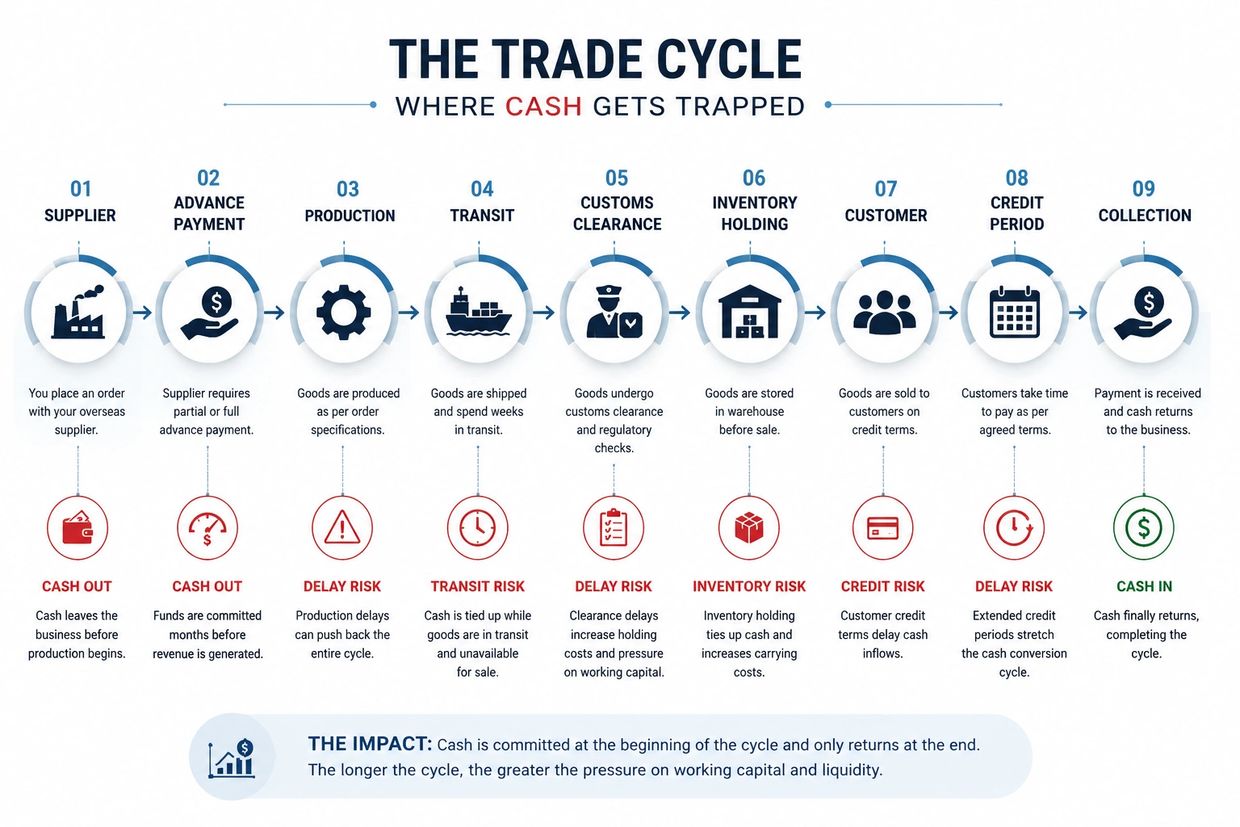
For many importing businesses, cash leaves the organisation long before revenue is collected. The trade cycle typically begins with supplier payments and continues through production, international transit, customs clearance, inventory holding and customer credit periods before cash finally returns to the business. While each stage may appear manageable in isolation, together they create a significant working capital commitment. The longer the cycle, the greater the pressure on liquidity. As businesses grow, increasing amounts of cash become tied up in inventory, transit periods and customer receivables, often creating a need for additional funding despite healthy sales performance. Understanding where cash is committed, how long it remains committed and what risks exist at each stage is the foundation of effective trade finance and working capital management.
Key Insight
Cash leaves the business at the beginning of the trade cycle but often returns only at the very end. The longer the cycle, the greater the pressure on working capital and liquidity.
UNDERSTANDING THE HIDDEN CASH TRAPS

Where Liquidity Is Lost Across the Trade Cycle
Five Hidden Cash Traps in International Trade
International trade extends far beyond buying and selling goods across borders. Every transaction creates a sequence of financial commitments that consume working capital long before revenue is realised. Many businesses assume that increasing sales will naturally strengthen cash flow. In practice, the opposite often occurs. As trade volumes grow, larger amounts of cash become committed to supplier advances, goods in transit, inventory, customer credit and foreign exchange exposure. These hidden cash traps gradually increase dependence on external funding while reducing liquidity and financial flexibility. Identifying where cash is committed—and why it remains committed—is the first step towards improving working capital performance and building a more resilient trade finance strategy.
Key Insight
Working capital is rarely trapped in one place. It is gradually locked across multiple stages of the international trade cycle. Businesses that improve visibility across these stages are better positioned to protect liquidity, reduce financing costs and support sustainable growth.

Profitability and Liquidity Are Not the Same Thing
In international trade, profitability and liquidity rarely move together.
A business may report healthy sales growth, strong gross margins and increasing profitability while simultaneously experiencing severe cash flow pressure. The reason lies in the trade cycle.
Cash is committed at the very beginning—through supplier advances, production funding, freight, duties and customs—while revenue is realised only after inventory is sold and customer payments are collected. This timing gap creates a significant funding requirement. Without an effective trade finance strategy, growing businesses often rely on additional borrowing simply to finance their operating cycle.
Trade finance is therefore not just about arranging Letters of Credit or supplier financing. It is about structuring the entire trade cycle so that cash is deployed efficiently, foreign exchange exposure is managed and liquidity is protected throughout the transaction lifecycle.
Businesses that understand this distinction are better positioned to support growth without placing unnecessary pressure on working capital.
Key Insight
Profitability measures commercial success. Trade finance ensures that international growth remains financially sustainable by protecting liquidity throughout the trade cycle.
Trade Finance Solution Framework
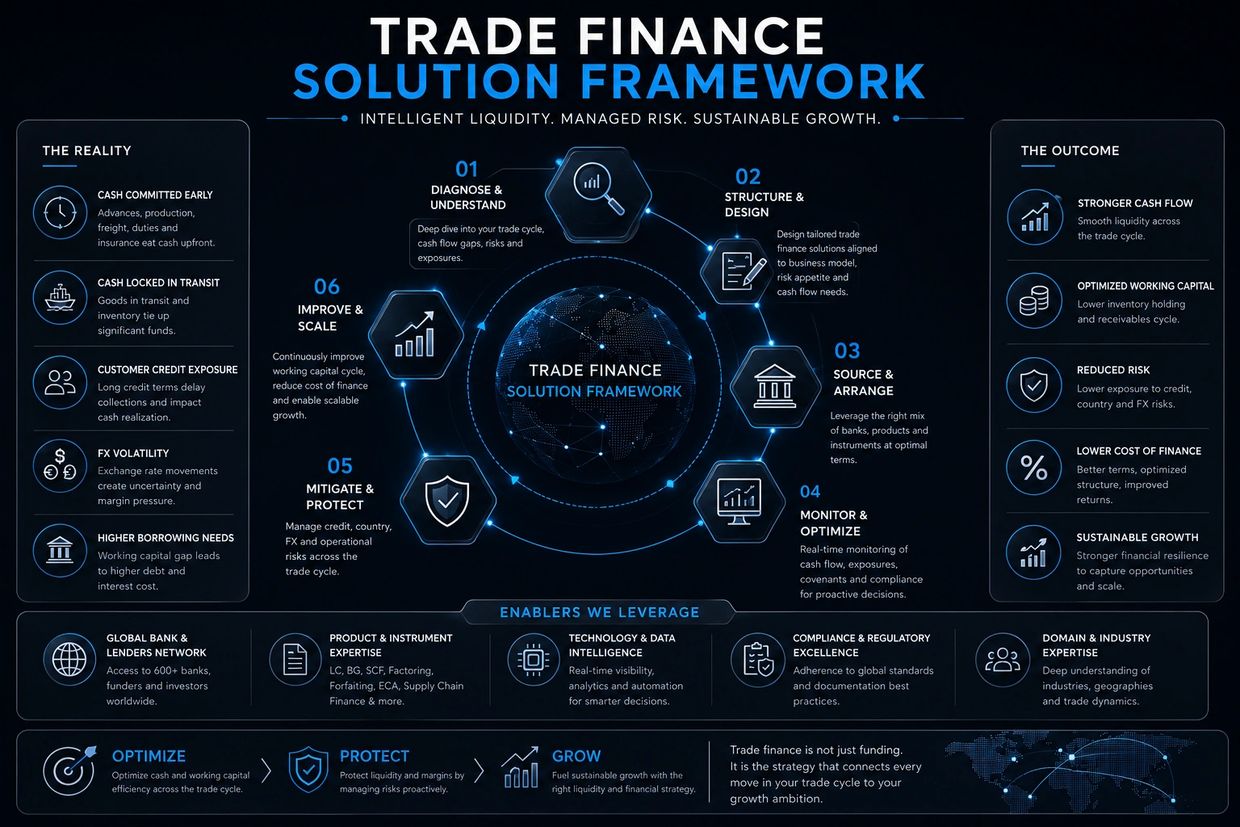
International trade is not simply about moving goods across borders. It is about managing the continuous movement of cash, documents, risk and information throughout the trade cycle. Every transaction requires a balance between liquidity, operational efficiency and risk management. When these elements are disconnected, businesses often experience unnecessary borrowing, delayed cash conversion and increased foreign exchange exposure.
At The Zentrix, we approach trade finance as a business strategy rather than a banking product. Our objective is to design a trade finance structure that supports growth while protecting liquidity at every stage of the international trade cycle. Our framework integrates working capital management, trade finance instruments, foreign exchange risk management and operational discipline into one structured approach. The result is improved cash visibility, reduced financing pressure and stronger financial resilience for growing international businesses.
How We Build Financial Resilience
🔹 Diagnose the complete trade cycle and identify working capital gaps.
🔹 Design the optimal trade finance and liquidity structure.
🔹 Arrange the right banking, funding and trade finance solutions.
🔹 Monitor cash flow, trade exposures and foreign exchange risks.
🔹 Protect margins through structured risk management.
🔹 Optimize working capital continuously as the business grows.
Key Insight
Trade finance should not be viewed as a source of funding. It should be viewed as a framework that connects cash flow, banking, operations and international trade into one integrated financial strategy.
FOREIGN EXCHANGE RISK MANAGEMENT
Why FX Matters
Strong operational performance does not guarantee stable profitability. In international trade, a single adverse currency movement can increase landed costs, reduce gross margins and create unexpected pressure on cash flow—even when procurement, logistics and sales are executed perfectly.
Foreign exchange risk is therefore not about predicting markets. It is about protecting commercial margins, improving cash flow visibility and ensuring that business performance is not determined by currency volatility. A structured FX risk management framework enables businesses to make informed decisions, improve financial planning and support sustainable international growth.
Business Impact
✔ Protect Commercial Margins
✔ Improve Cash Flow Predictability
✔ Reduce Earnings Volatility
✔ Strengthen Pricing Decisions
✔ Support Sustainable Growth
Key Insight
The biggest threat to profitability is often not operational inefficiency—it is unmanaged currency risk.
HEDGING STRATEGY

Managing Currency Risk Through Structured Hedging
Currency markets cannot be controlled, but currency exposure can. For importers and exporters, foreign exchange volatility has a direct impact on landed costs, gross margins, pricing decisions and cash flow. Even profitable businesses can experience significant earnings fluctuations if currency risk remains unmanaged. A structured hedging strategy transforms foreign exchange management from a reactive activity into a disciplined financial process. Rather than attempting to predict market movements, the objective is to reduce uncertainty, improve planning accuracy and protect commercial profitability. The most effective hedging programmes align treasury decisions with procurement, sales and cash flow requirements, ensuring that business performance is driven by operational excellence—not by currency fluctuations.
The Hedging Process
✔ Identify Currency Exposure
✔ Assess Cash Flow Timing
✔ Select Appropriate Hedging Instruments
✔ Monitor Open Positions
✔ Protect Commercial Margins
Business Benefits
🛡 Protect Gross Margins
📅 Improve Cash Flow Forecasting
🎯 Support Better Pricing Decisions
📉 Reduce Earnings Volatility
🏦 Strengthen Banking Relationships
📈 Enable Sustainable International Growth
Key Insight
Successful hedging is not about predicting exchange rates. It is about creating certainty where uncertainty already exists.
"The objective of hedging is not to generate profit from currency movements. The objective is to protect the profit your business has already earned".
THE FINAL THOUGHT
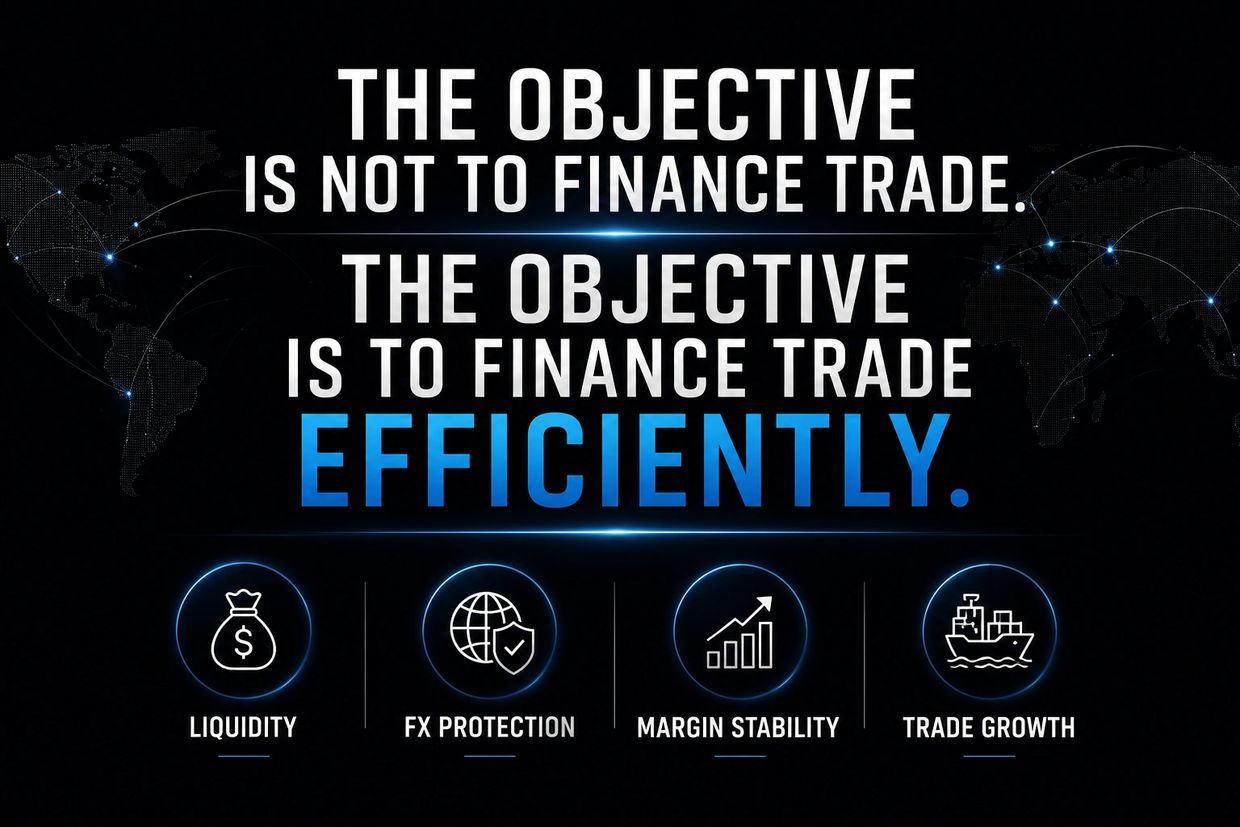
Intelligent Trade Finance is not about borrowing more. It is about building a business that grows with stronger liquidity, controlled risk and sustainable cash flow.
Illustrative Trade Finance Transformation

Business Challenges
- Long supplier payment cycles
- High inventory funding requirements
- Rising foreign exchange exposure
- Heavy dependence on working capital facilities
- Limited cash flow visibility
Trade Finance Performance Improvement
Illustrative operational improvements following trade finance optimisation.

Key Outcome
"The objective was not to increase borrowing capacity. The objective was to improve liquidity, reduce funding pressure and create a trade finance structure that supports sustainable international growth."