Executive Summary
SITUATION:
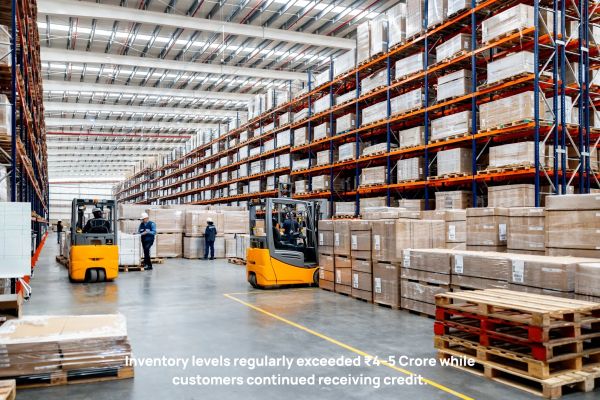
In April 2024, management requested preparation of documentation for an additional ₹3 Crore working capital facility for a super distribution business. At the time, the conclusion appeared obvious. Monthly sales were approximately ₹6–7 Crore. Inventory levels exceeded ₹4–5 Crore.Customers were receiving credit. The principal company required advance payment before dispatching goods.More than ₹1 Crore remained regularly blocked in outstanding claims and promotional reimbursements.The business appeared to need additional funding. However, after a detailed review of operations, inventory, customer behaviour, claims recovery and ordering practices, a different conclusion emerged.
CHALLENGE:
The business did not have a funding problem.It had a working capital problem.Over the following six months, a structured transformation programme released more than ₹3 Crore of cash, improved profitability, increased monthly sales from approximately ₹6–7 Crore to ₹9–10 Crore and ultimately eliminated the need for the additional facility.The same facility that had originally been considered essential was surrendered within six months.

the bank was ready to lend
The starting point, preparations for an additional ₹3 Crore working capital facility were already underway. Financial statements were being compiled.
Banking discussions had started. Internal teams believed additional funding was the natural solution to support growth. The assumption throughout the organisation was simple: "Higher sales require higher funding." Very few people were asking a different question. Could existing cash be released before taking on additional debt?
That question became the foundation of the entire project.

THE FIRST QUESTION
The Assignment
A Simple Request
The project began with a simple instruction from the Managing Director. "Prepare the papers. We need a ₹3 Crore working capital facility."
At first, the request appeared routine.
The business was growing. Inventory levels were increasing. Customers were receiving credit.
Cash flow remained under pressure. An additional facility appeared to be the logical solution.
While preparing the banking proposal, a simple question was raised: "What exactly is driving the funding requirement?"
The response was straightforward.
"Spend some time at the business. You'll understand."
That decision ultimately changed the direction of the entire project. What initially appeared to be a funding requirement gradually revealed itself as a much deeper operational challenge. The objective was no longer to secure additional borrowing.
The objective became understanding where cash was actually being consumed.
Understanding the Business
The company operated as a super distributor managing approximately 2,500–3,000 products. Monthly sales averaged between ₹6–7 Crore. The business model created pressure at almost every stage of the working capital cycle.
Inventory
The principal company required significant stock availability at all times. Inventory levels typically ranged between ₹4–5 Crore. Every purchase required advance payment.
Customers
Customers routinely received credit ranging from 7–15 days.
Company Schemes and Claims
Promotional schemes were regularly launched by the principal company. The benefits were immediately passed on to customers.
However, reimbursement claims were often received after 60–90 days and sometimes even later. As a result, approximately ₹1–1.5 Crore remained blocked in claims at any given time.
THE REAL PROBLEM
After several weeks of observation, one thing became increasingly clear.
The business was preparing to borrow additional money while significant amounts of cash remained trapped inside operations.
The issue was not sales.
The issue was not profitability.
The issue was working capital efficiency.
At this stage, a critical observation emerged.
The business was preparing to borrow approximately ₹3 Crore from the bank while potentially having more than ₹3 Crore already trapped inside operations.
That realization changed the direction of the project.

Phase-1 : Inventory Rationalization
Categorization

The first step was understanding inventory quality. Inventory was classified into: Fast Moving, Moderate Moving, Slow Moving, Non-Moving, Dead Stock Near Expiry Stock. The findings were revealing. Large quantities of inventory had either not moved for extended periods or were moving far slower than management realised. Yet fresh inventory continued to be purchased every month.
Resistance Begins

The recovery programme was not welcomed by everyone. Company representatives preferred focusing on fast-moving products.
Their objective was simple: Generate fresh orders, Increase sales volume, Push new schemes, My objective was different.
Release trapped cash. As slow-moving and non-moving inventory was pushed into the market, resistance increased. Representatives argued that customers would not accept, such products. Complaints were raised with management. Concerns were escalated to the principal company. The feedback was consistent. “This is not how we normally do business.” Fortunately, the Managing Director remained supportive. His response was simple:
“Let him do what he is doing.” That support became critical.
Turning Inventory into Cash

A structured inventory recovery programme was implemented. Dead Stock: Dead inventory was liquidated at discounted prices.
The objective was not margin protection.
The objective was cash recovery.
Near Expiry Inventory: Special schemes were introduced to accelerate movement before expiry.
Slow Moving Inventory: Customers purchasing fast-moving products were encouraged to take selected slow-moving items as part of broader commercial arrangements. Many initially resisted.
Over time, inventory that had remained untouched for months began moving.
The philosophy was simple.
Inventory sitting in a warehouse creates no value. Cash does.
The Moment Everything Started Going Wrong
The Moment Everything Started Going Wrong
By May 2024, the inventory rationalisation programme had begun to gain momentum.
Dead stock was being liquidated. Slow-moving inventory was being pushed into the market.
Near-expiry products were being cleared. From a finance perspective, the results were encouraging. From a sales perspective, they were controversial. Company representatives began questioning the approach. Several argued that management should focus on generating fresh orders rather than clearing ageing inventory. One representative remarked during a review discussion:
“Why are we pushing products customers don't want? We should focus on products that move quickly.” From his perspective, the argument was logical. From a working capital perspective, it was exactly the problem.
Every new order increased inventory commitments while existing slow-moving inventory continued consuming cash. The objective was not to sell more inventory.
The objective was to convert existing inventory into cash. The distinction was important. Not everyone agreed.
the Result
The Moment Everything Started Going Wrong
the Result
The inventory rationalisation programme delivered immediate and measurable results. By systematically classifying stock into fast-moving, slow-moving, near-expiry and dead inventory categories, the business was able to identify significant amounts of cash trapped in non-productive stock. Through targeted liquidation, promotional schemes and improved inventory discipline, approximately ₹1 Crore of working capital was released. More importantly, inventory levels became healthier, stock visibility improved and management gained greater control over future purchasing decisions.
Key Outcome: ₹1 Crore of cash released without additional borrowing.
phase-2: CUSTOMER CREDIT DISCIPLINE
A Difficult Decision

A decision was made to gradually move customers towards advance payment.
Resistance was immediate.Customers complained. Several escalated concerns directly to management. Sales slowed sharply.
For nearly two weeks, business activity reduced significantly. The Managing Director called and asked:“What is happening?”
My response was simple.
“Give me some time.”
The Moment Sales Started Falling and Customer Pushback

The resistance became even stronger when customer credit policies were reviewed.
Historically, customers had become comfortable receiving 7–15 days credit.
For many customers, credit had become an expectation rather than a commercial concession. When advance payment requirements were introduced, the response was immediate. Phone calls increased.
Complaints increased. Several customers contacted senior management directly.
Some openly stated:“If credit is stopped, we will move our business elsewhere.”
For nearly two weeks, sales slowed dramatically. Orders that would normally arrive every day stopped appearing. The atmosphere became uncomfortable. Employees became nervous. Representatives became vocal.
Management became concerned. For the first time, genuine doubt began to emerge.
The Call from The Managing Director

One afternoon, the Managing Director called.
His question was simple.“What exactly is happening?” Sales had fallen. Customers were unhappy. Representatives were complaining. Pressure was increasing from every direction. My response was equally simple. “Give me some time.” At that stage there were no guarantees. The strategy could still fail. Customers could refuse the changes.
Sales could continue declining. The easiest decision would have been to return to the previous model. Continue giving credit.
Continue carrying excess inventory. Continue waiting months for claims. Continue borrowing more money. Instead, the programme continued.
The easiest decision would have been to reverse course. The right decision was to stay the course.
Creating a Balanced Solution

To encourage adoption, a structured incentive programme was introduced. Customers paying in advance received an additional 1% commercial benefit. Credit periods were reduced significantly.
Initially there was strong resistance. However, commercial reality eventually prevailed. Within two to three months, most customers had transitioned towards advance payment arrangements.
Resistance Turned Into Acceptance

Within two to three months, customer behaviour began changing. Advance payments increased. Collection cycles shortened.
Outstanding receivables reduced significantly.
Most importantly, the business no longer needed to fund customer operations from its own working capital. What initially appeared to be a sales risk gradually became a cash flow improvement programme.
What initially appeared to be a sales risk gradually became a competitive advantage. Improved liquidity enabled faster inventory replenishment, stronger supplier relationships and better commercial flexibility.
Phase 2 Outcome

Through disciplined collection management and customer payment restructuring:
₹1–1.5 Crore of Working Capital Released
- Customer credit reduced substantially
- Collection cycles improved
- Cash availability increased
- Dependence on external funding reduced
"The objective was never to stop selling. The objective was to stop financing the market."
PHASE 3 : CLAIMS RECOVERY & PRINCIPAL COMPANY NEGOTIATIONS
Claims Bottleneck

The next battle involved claim recoveries.
At any point in time, ₹1–1.5 Crore remained blocked with the principal company.
The situation created significant frustration.
Customers received scheme benefits immediately. The distributor funded the cost immediately. Yet reimbursement often took months. Repeated follow-ups produced limited results.
Escalation & Negotiation

As delays continued, the issue was escalated beyond routine operational discussions. Several conversations took place with senior representatives of the principal company. The concern was straightforward.
The distributor funded the schemes.
Customers received the benefit immediately.
Yet reimbursements often took months to arrive. The message was clear:
"If distributors are expected to support market growth, reimbursement cycles must support distributor liquidity."
The discussions were not always comfortable.
However, they proved productive.
Discussions took place directly with senior leadership of the principal company.
The message was straightforward:
“The distributor cannot continue financing the entire process indefinitely.”
The discussion was uncomfortable.
But it was necessary. As discussions continued, the matter eventually reached senior leadership. The issue was no longer individual claims. It had become a working capital and distributor sustainability issue. Shortly afterwards, a structured resolution process began to emerge.
Process Transformation
Process Transformation

Shortly afterwards, historic claims began getting released. More importantly, a structured monthly settlement process was introduced.
For the first time, predictability replaced uncertainty.
Cash Released
₹70–80 Lakhs Released Through Claims Recovery
- Historic claims settled
- Monthly settlement cycle established
- Predictability improved
- Liquidity strengthened
PHASE 4 : ORDERING DISCIPLINE & GROWTH

The Ordering Problem
The final opportunity involved inventory replenishment.
Historically, orders were placed approximately four times per month.
Large advance payments remained blocked with the principal company.
Building a New Ordering Cycle
After analysing movement patterns, a different model was introduced.
Instead of placing large periodic orders, smaller replenishment orders were placed every five days.
This created: Lower inventory holdings, Reduced advance, funding requirements, Better stock visibility, Improved replenishment accuracy
Liquidity Meets Growth
Our team consists of experienced consultants with diverse backgrounds and areas of expertise. We are passionate about helping businesses succeed and are committed to delivering exceptional service to our clients.

Ordering Discipline and Growth
The final phase of the transformation focused on ordering discipline. By moving from large monthly purchases to structured replenishment cycles, the business reduced advance funding requirements, improved inventory planning and released approximately ₹50 Lakh of additional liquidity. Combined with inventory optimisation, customer credit discipline and claims recovery, this enabled the business to achieve higher sales while significantly reducing working capital pressure.
Transformation summary
What began as a request for an additional ₹3 Crore facility evolved into a six-month working capital transformation programme. Through inventory rationalisation, customer credit discipline, claims recovery and ordering optimisation, more than ₹3 Crore of liquidity was released. The result was stronger cash flow, improved sales performance and the elimination of the proposed borrowing requirement.